
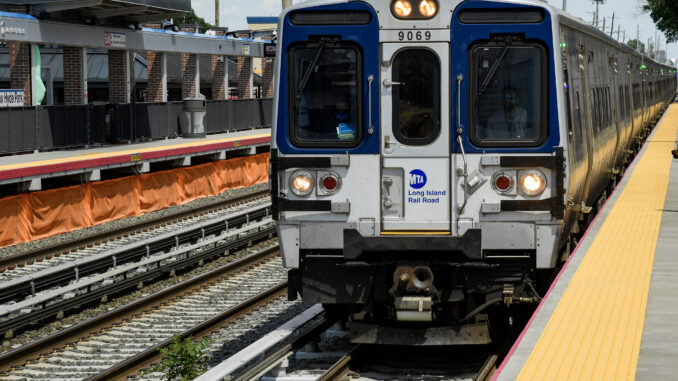

By Hank Russell
A coalition of five railroad labor unions were told that they should receive raises and back pay, according to a decision made by a special board whose members were appointed by President Donald Trump.
Presidential Emergency Board (PEB) 254, the second board assigned to the long-running contract dispute between a coalition of five railroad unions and the Long Island Rail Road (LIRR), like an earlier appointed board, recommended raises and retroactive pay for members of the Brotherhood of Locomotive Engineers and Trainmen (BLET), the Brotherhood of Railroad Signalmen (BRS), the International Association of Machinists and Aerospace Workers (IAMAW), the International Brotherhood of Electrical Workers (IBEW), and the Transportation Communications Union (TCU), also known as The Long Island Railroad Bargaining Coalition. The coalition requested a second PEB, citing the Railway Labor Act.
The board also rejected the employer’s request for sweeping changes to contract language, stating, “…the Carrier’s insistence on all of its work rule changes, in our view, makes its Final Offer the less reasonable of the two, regardless of the respective GWIs [general wage increases.”
The first PEB was also requested by the unions. As previously reported in Long Island Life & Politics, the union representing LIRR engineers has decided not to go on strike this week. Rather, they called on Trump to bring in a National Mediation Board. BLET members, along with the members of four other rail unions, have been without a pay raise for over three years. The LIRR offered a 9% pay raise over three years, but BLET wanted an additional 6.5%. According to the LIRR, a possible strike would have affected 270,000 daily riders.
ABC News reported that 99% of the unionized 529 LIRR engineers voted for the strike, but BLET is calling on the federal government to intervene. If an agreement is not reached by May, the engineers will walk off the job, LILP previously reported.
Under the rules of the Railway Labor Act, the PEB was charged with selecting the most reasonable last offer; either from the unions in its entirety, or from the LIRR, which is owned and operated by the Metropolitan Transportation Authority (MTA). After comparing the two offers, the board selected the unions’ offer.
The board found that at this late stage in the Railway Labor Act bargaining process, final negotiations should not be derailed by MTA’s belated calls for sweeping changes to work rules.
In a letter sent today to the MTA, representatives of the five unions urged the MTA to return to the bargaining table to reach a voluntary agreement using the PEB’s recommendations as a foundation for a settlement. According to the coalition, members of the five rail unions, comprising a majority of LIRR’s unionized workforce, have been without a pay raise since April 2022, despite near record inflation. If no agreement is reached in the next 60 days, the unions would be allowed to strike as soon as May 16 under the rules of the Railway Labor Act or the MTA could lock out its rail labor workforce on that date.
“Let’s get back to the bargaining table and agree to a fair settlement that takes away the threat of a disruption in service,” said Brotherhood of Locomotive Engineers & Trainmen Vice President Kevin Sexton, speaking on behalf of the labor coalition.
“What we’ve been asking for since negotiations commenced more than two years ago is exceedingly reasonable, essentially the status quo. In stark contrast, the employer has been seeking a concessionary contract that doesn’t keep pace with the high cost of living in our metropolitan area,” said Mike Sullivan, who serves as general chairman of the Brotherhood of Railroad Signalmen.
“This outcome confirms that our fight has been grounded in facts, equity, and the best interests of our members,” said Shaun O’Connor, general chairman of the International Association of Machinists and Aerospace Workers.
“The Board’s report confirms that labor acted responsibly throughout this process and deserves a fair contract,” said Jeffrey Klein, who serves as general chairman of the International Brotherhood of Electrical Workers.
“Our labor coalition and management both made presentations to the board,” said Nick Peluso, national vice president of the Transportation Communications Union. “The board members reviewed the facts, and the facts supported labor. It’s now the time for our employer and Governor Hochul to show some support for the workers and the commuters that rely on the LIRR. Let’s get this done and keep the trains running.”
The board members in their report made it clear that MTA should bargain in good faith, writing, “Based on the foregoing analysis of both the respective wage offers and the Carriers work rule proposals, we find that the Organizations’ (the unions) Final Offer is the most reasonable offer.”
LILP reached out to the MTA. Anita Miller, the agency’s chief labor and employee relations officer said, “We are disappointed, but not surprised, that this Trump-appointed Board rejected the MTA’s common-sense proposal for a new LIRR labor contract. These unions have hidden from the normal give and take of collective bargaining. They are the highest-paid railroad workers in the nation but have refused the same significant wage increases the vast majority of their colleagues accepted – and repeatedly refused to negotiate.”
Miller said the MTA could initiate a “needless” work stoppage if the coalition does not begin to negotiate in good faith, which would “only hurt both riders and workers. In the meantime, we will take every available step to mitigate the impact of a potential strike on LIRR customers. And should these unions decide to come to the table in good faith, we have been, and are, ready to go.”