


By Elaine Phillips
As we watch the drama unfold around the budget planning for New York State, Nassau County taxpayers should be aware of the impact the state budget has on our wallets. Under New York State’s progressive budgeting, wealthier counties subsidize the state’s operations, with Nassau sending billions more dollars to Albany than we get back in funding.
Nassau residents help make it possible for the state to balance its budget and Albany owes it to our taxpayers to respect that contribution by maintaining fiscal discipline. Instead, the proposed state budget continues to feature out-of-control spending that will cause Nassau’s role in subsidizing the state to grow even larger.
 Every year, Nassau County residents send billions of dollars to the state. You pay state income taxes, MTA taxes, state taxes on gasoline, your driver’s license, vehicle registrations, beer, wine and liquor, tobacco products, estate and real estate transfers, and more. In 2025, Nassau sent $9.6 billion to Albany and received $4.8 billion in state funding.
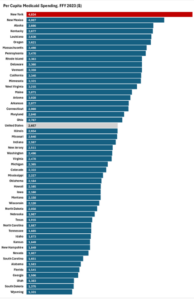
With the unveiling of the governor’s proposed budget for 2026-27, we looked at some of the state’s spending, starting with Medicaid, New York’s largest expense. Last year, we published an important exposé on Medicaid spending, in which we reported that NYS spends more in Medicaid than Florida and Texas combined, despite having a population smaller than either. In terms of per capita spending, New York far exceeds every other state in the entire country in Medicaid spending. Despite a 33% increase over the past five years, the proposed budget calls for an increase of another 5%.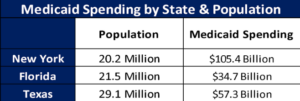
New York State leads the nation in education spending — more than $33,000 per pupil, 91% above the national K-12 average. Yet, New York State posts barely average academic outcomes. The state’s fourth- and eighth-graders are of average proficiency in reading and are slightly below average in math. Only 31% of New York eighth-graders were proficient in reading; only 26% were proficient in math. The state’s education spending has increased by 28% over the past five years and will go up another 4% under the terms of the proposed budget.
The problem is that the state’s spending is out of control. Affordability is the new buzzword, but New York State’s two highest expense categories continue to increase exponentially while revenues remain virtually flat.
Even Comptroller Tom DiNapoli said the state has “a structural imbalance where spending projections far outpace receipts projections.” According to experts, including DiNapoli, the imbalances are at levels not seen since the global financial crisis of 2009.
Each of us is expected to manage our family’s budget, despite rising costs, and somehow we make it work. How? We control our spending and work within a budget.
So what is their solution? The state would continue to milk the wealthier counties by taxing virtually everything we do and buy. We understand the principle of wealthier counties subsidizing a larger share of the budget, but as a net contributor, Nassau’s burden is growing.
We give disproportionately, and at a rate much higher than what we get back in state funding. The gap between what Nassau sends to the state and what we receive is $4.8 billion and has increased by 46%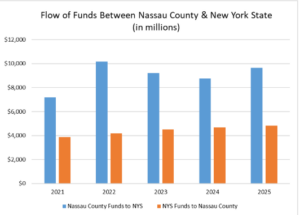 over the past five years.
Suffolk County also pays more than it receives. Suffolk’s gap increased 55% over the past five years to a gap of $3.8 billion.
Over the last 15 years, Nassau’s funding gap has increased a staggering 250%!
While residents and businesses continue to tighten their belts in order to balance their own budgets amid rising costs, New York State just continues to spend.
Nassau County has not raised taxes on our residents or businesses for the past four years, yet we continue to subsidize the state.
DiNapoli had this to say in his Report on the State Fiscal Year [2026-]2027 Executive Budget: “The trajectory of State spending has been steep, and is projected to continue to increase faster than inflation and projected revenues. As a result, the [NYS] Division of the Budget projects cumulative budget gaps of $27.5 billion between State Fiscal Years 2028 and 2030.”
The New York State budget is due to be finalized by April 1. Our state’s elected officials must consider the implications of the out-of-control spending included in the governor’s proposed financial plan. Nassau County taxpayers should not be expected to subsidize outrageous and irresponsible budgeting.
Elaine Phillips is the Nassau County Comptroller.