

By Hank Russell
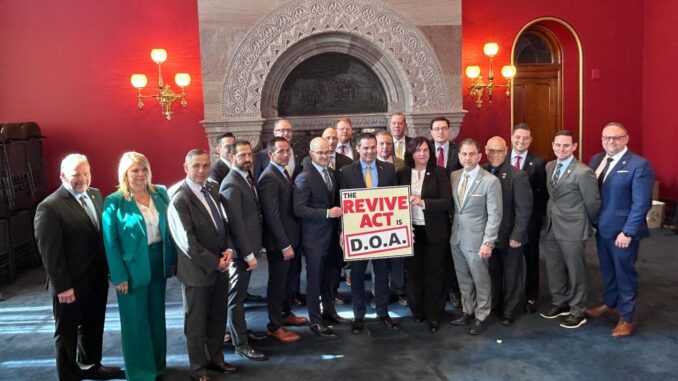
Republican members of the state Legislature held a press conference on March 24 to express their opposition to a housing bill that they said would strip local communities of their ability to shape their own future. They also said it would negatively impact Long Island’s suburban quality of life.
The REVIVE (Redeveloping Empty and Vacant Infrasturcture for Vibrant Economies) Act, sponsored by Michaelle Solages (D-Valley Stream), would permit the conversion of large, vacant or underused commercial properties larger than 15,000 square feet into residential developments, bypassing local zoning laws and municipal oversight.
“[M]any of these properties are in decline due to changing economic conditions, evolving consumer preferences, and the rise of alternative retail and business models,” the bill reads. “Many such centers and their parking lots have become underutilized or outright vacant. … At the same time, New York is confronting a severe housing crisis that demands an aggressive, coordinated response.”
Converting these properties into housing “would promote the general welfare by revitalizing underused properties, creating new opportunities for housing, businesses, and recreation, and strengthening the economic and social vitality of New York’s municipalities,” according to the bill. However, it is “the continued application of outdated and rigid municipal zoning regulations that unnecessarily separate residential and commercial uses” that are getting in the way.
“To promote the development of dynamic, mixed-use communities that serve both local and statewide interests, it is appropriate for the Legislature to establish standards that remove barriers to the redevelopment of stranded assets, while balancing the desires of municipalities, to unlock numerous housing opportunities for everyday New Yorkers,” the bill reads.
Local elected officials were unhappy with this legislation. Among the things this bill would do include declaring qualifying housing projects “permitted by right,” thereby overriding local zoning, site plan discretion and the ability of municipalities to say no; imposing statewide control over density, height and parking for certain projects, preventing local boards from tailoring size and scale to neighborhood conditions; establishing fast-track approvals and automatic approvals if deadlines are missed, sidelining local boards and residents; and limiting municipal review only to holding “non-binding design review” hearings.
“Top-down mandates from Albany don’t work, and the REVIVE Act falls squarely into that category,” said Assembly Minority Leader Ed Ra (R-Franklin Square). “There’s no question we need to tackle New York’s housing shortage, but you don’t solve a statewide issue by stripping local communities of their ability to make decisions that directly impact their neighborhoods. Local zoning exists for a reason, and any real solution should empower communities — not silence them.”
“Once again, Gov. Hochul and Albany extremists are pushing a top-down, one-size-fits-all mandate that strips municipalities of their authority over local zoning,” said Town of Hempstead Supervisor Ferretti. “These heavy-handed policies ignore the unique needs of our communities and silence the voices of the residents. Local decisions belong in local hands—not dictated from Albany.”
Assemblyman Keith Brown (R.C-Northport) stressed that Long Island communities are already under pressure from rising costs, crowded infrastructure and increasing demand on local services and he warned that the proposal could accelerate those challenges without proper planning.
“Long Island is not a blank slate for Albany to experiment with,” said Brown. “Our roads are already congested, our schools are near capacity and our infrastructure is being pushed to its limits. Forcing high-density housing into areas without local input is a recipe for disaster, both financially and environmentally.”
Assemblyman Ari Brown (R-Cedarhurst), the Ranking Minority Member on the Assembly Committee on Local Governments, called the legislation a “city-driven ideology being forced onto suburban communities that live very differently from New York City. On Long Island, we still believe traffic matters, drainage matters, parking matters and local communities, not Albany, should decide what belongs in their own backyard.”
North Hempstead Town Supervisor Jennifer DeSena agreed. “Year after year, Kathy Hochul pushes shortsighted policies to override our local zoning with a one-size-fits-all approach that fails to reflect the needs of Long Island’s suburban communities,” she said.
Keith Brown also pointed to the broader pattern of state mandates that shift costs and responsibilities onto local governments and taxpayers. “This isn’t just about zoning, it’s about who pays the price,” he said. “Albany creates the mandate, and Long Island families are left dealing with the consequences, whether it’s overcrowded roads and classrooms, strained emergency services or higher property taxes.”
State Senator Patricia Canzoneri-Fitzpatrick (R,C-Valley Stream) said this bill would “turn Nassau County into the sixth borough of New York City,” adding. “Local governments must retain the ability to make decisions that reflect the character, needs and priorities of the people they serve,”
While acknowledging the need to address housing availability, Brown emphasized that sustainable solutions must be developed at the local level with direct community input.
“We all want to see smart redevelopment and vibrant communities, but those decisions must be made by the people who live there,” Brown said. “Zoning from Albany ignores the realities of Home Rule and undermines the very communities they claim to help. The bottom line is simple: Decisions about our communities should be made in our communities. It is a cornerstone of New York State government.”
“Zoning exists for a reason — and this bill tramples over it,” state Senator Steve Rhoads (R,C-Levittown) added. “[I]nstead of asking why commercial properties are sitting vacant in the first place, Albany should take a hard look at the crushing regulatory burden it has placed on our small businesses, over 300,000 regulations, among the highest in the nation. This is not smart growth—it’s state-imposed overreach.”
Long Island Life & Politics reached out to Hochul’s office. Spokesperson Gordon Tepper said the governor does not review or comment on legislation that has yet to pass both chambers of the state Legislature, but added, “Mischaracterizing a legislative proposal as a mandate is simply inaccurate.” He also referred LILP to the bill’s sponsors for more information.
“Governor Hochul’s Pro-Housing Communities approach is rooted in partnership with local governments, respecting local control while incentivizing smart, community-driven development,” Tepper said. “Political rhetoric from some GOP officials about ‘one-size-fits-all mandates’ does not reflect reality.”