
Program Raised $468 Million in 2025 As Tolls, Fares Rise Again
Blakeman Calls for MTA Control Board
By Hank Russell
A day before Governor Kathy Hochul called congestion pricing a success, the Metropolitan Transportation Authority (MTA) raised fares on Long Island Rail Road (LIRR) and MTA riders. This led critics to ask why fares had to be hiked if the congestion pricing program seemed to be working.
As previously reported in Long Island Life & Politics, the Central Business District Tolling Program went into effect on January 5, 2025. Drivers who drive below 60th Street in Manhattan are required to pay a $9 congestion pricing toll. The MTA said congestion pricing will greatly reduce gridlock and result in cleaner air and improved transit.
The program was also the subject of lawsuits filed by the Trump administration. LILP also reported that a state judge ruled against the federal government, telling them they could not withhold federal funding if the state implements the program.
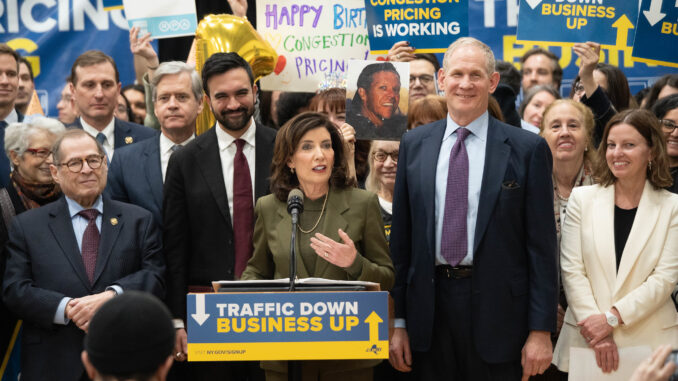
During the press conference held on January 5, Hochul extolled congestion pricing, claiming that, in addition to the reduction in traffic in the Congestion Relief Zone (CRZ) and emissions, $468 million was raised from January 5, 2025 to October 31, 2025; the MTA said they were on track to hit $500 million by the end of the year.
“The results are in and it is clear that in just one year, congestion pricing has been an unprecedented success in New York,” Hochul said. “By every measure, this program has met or exceeded expectations: traffic and gridlock are down substantially, people are moving faster, air quality is improved, streets are safer and our economy is stronger. New Yorkers are benefitting from congestion pricing every day, and that’s why we have fought to stop any unlawful federal attempt to end this program.”
However, on January 4, LIRR riders had to fork over more money to ride the train. According to The New York Post, the prices for weekly and monthly passes went up 4.5% — equivalent to an extra $7 to $21 — while off-peak one-way and other ticket prices increased by 8%.
Without mentioning the fare hikes, Hochul announced that sales tax revenue in the CRZ rose by 6%. “I mean, people are still coming, they’re still shopping, they’re still spending money,” she said, dismissing the congestion pricing opponents as “doomsayers.”
However, Bruce Blakeman, the Nassau County executive who is running against Hochul for governor this year, blasted her for only talking about affordability, while allowing these rate hikes to continue.
“Enough is enough with Kathy Hochul’s empty promises on affordability,” Blakeman fired back. “Hochul rammed through congestion pricing – a new tax on drivers – bragging it would fund the MTA and ease burdens. So much for that fairy tale! Now, with congestion cash rolling in, fares are skyrocketing for the very commuters who can’t afford another hit.”
Blakeman said Hochul has done nothing to stop fare evasion, costing the MTA hundreds of millions of dollars a year. “If the MTA needs money, start by going after the people who don’t pay,” he said. “Law-abiding riders shouldn’t be treated like an ATM while fare beaters walk through the turnstiles for free.”
Blakeman said that, as governor, he would restore accountability at the MTA by cracking down on fare evasion and collecting the revenue already owed before asking commuters to pay more. Additionally, he vowed to audit the MTA, rein in waste and mismanagement, and stop hitting up riders to cover Albany’s failures. “New Yorkers deserve a transit system that is safe, affordable, and fair,” Blakeman said. “As governor, I’ll make sure the rules are enforced, the money is spent responsibly, and law-abiding riders are respected — not punished.”
LILP reached out to Hochul’s office and was referred to the video and transcript of the press conference. This reporter also reached out to the MTA, but did not hear back as of press time.
LILP also asked Blakeman if he would implement a financial control board — something this outlet has constantly called for. He replied, “An independent MTA oversight board would finally protect commuters—auditing spending, exposing billions in waste, and cracking down on fare evasion that drains hundreds of millions of dollars every year — so fares stop rising and service stops falling.”