

By Hank Russell
Affordability was a recurring theme at Vision Long Island’s 2025 Long Island Smart Growth Summit, which was held on December 5 at the Crest Hollow Country Club in Woodbury. During the daylong event, local elected officials spoke about the need for more affordable housing on Long Island.
Some of those said these development projects in their downtowns would not be possible, had it not been for the PILOT (Payment in Lieu of Taxes) payments. As they touted the benefits of this program, those with the Industrial Development Agencies (IDAs) addressed criticisms that the program allowed developers to avoid paying taxes on the properties.
Ralph Ekstrand, the mayor of Famingdale Village, noted that his village has been named the best downtown area by The Long Island Press for the last 15 years. The village has continued to build up its downtown, thanks to the help of PILOTs. “PILOTs really help downtown villages,” he said.
Hempstead Village Mayor Waylyn Hobbs, Jr. agreed, saying PILOTs provide “a good opportunity” for local governments.
Ed Fare, the mayor of Valley Stream, said PILOTs can help if a developer purchases “a blighted area” that had been off the tax rolls “for a fraction of what the property was worth.”
However, “we have to be careful” when it comes to discussing PILOTs, said Glen Cove Mayor Pamela Panzenbeck. “People think PILOTs means paying no taxes, and that’s the problem. We need to educate people [about PILOTs].”
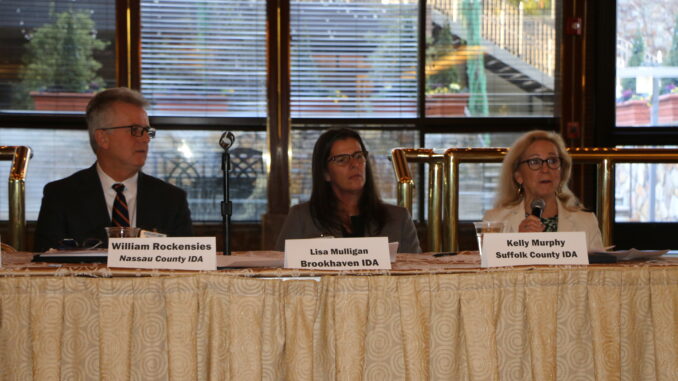
Nassau County IDA Board Member William Rockensies also disabused the notion that IDAs throw money at these development projects. “We’re not a bank,” he said. “We don’t give away money.” Rockensies said “PILOTs are so important” and emphasized that the taxes are “phased in over the years” and the program “helps get projects off the ground.”
Kelly Murphy, executive director of Suffolk County IDA, who said she has done “a lot of housing projects over many years,” explained there is an enhanced PILOT program for residential developers. In order to be eligible, the project — once it is approved — must include the installation of solar panels and setting aside 10% to 20% for affordable housing. “[The developers] will also get enhanced PILOTs if [units are set aside] for veterans, the disabled and seniors,” she said.
Anthony Bartone, the managing partner with the Farmingdale development firm Terwilliger & Bartone Properties — which has the Cornerstone at Kings Park project in its portfolio — was in the audience. He sounded off on “armchair social media warriors” who are making unsubstantiated claims that “developers do not pay taxes. Do me a favor and stop it.”
“Taxes do not go down,” Bartone said, echoing what the other panelists said, adding it’s “an abatement” of taxes. “It’s basic economics.”