

By Hank Russell
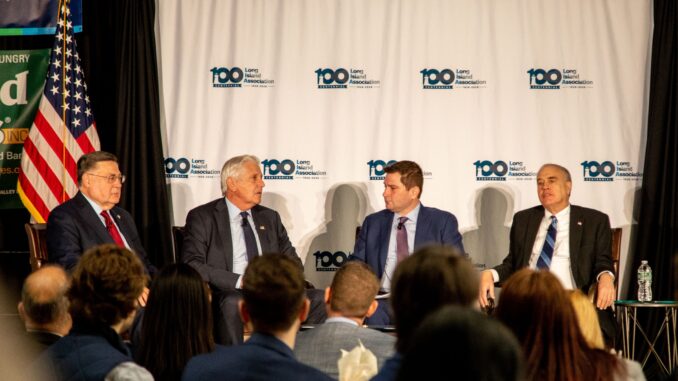
The Crest Hollow Country Club in Woodbury was the site of the Long Island Association’s (LIA) State of the Region breakfast, which took place on January 9. Suffolk County Executive Ed Romaine, Nassau County Executive Bruce Blakeman and New York State Comptroller Tom DiNapoli spoke at the annual roundtable, where the focus was on affordability and the future of energy.
The first guest speaker, U.S. Senator Chuck Schumer, addressed those needs. “We all need to improve our downtowns,” he said. “We need to build a better path to homeownership so that the next generation can build their own independent lives. Homeownership is a key to Long Island.”
Blakeman called for the creation of an affordable housing program, but, more importantly, giving control of the local governments. “We need to have local control and smart growth, not the control to be determined up in Albany,” he said.
“We need to increase the supply of housing,” Romaine added. “And you don’t want overdevelopment. That’s the wrong thing. What you want is intelligent development.”
DiNapoli noted that, in one of his reports, Long Island’s younger generation is having a more difficult time purchasing a home. “Those issues really impact the 18- to 34-year-olds,” he said. “Homeownership is getting further out of reach. The average age of the homeowner is getting pushed further and further.”
One reason, DiNapoli said, is the lack of entry-level jobs. “The number of entry-level jobs seems to be shrinking. Some of it is the beginning of consequences of artificial intelligence, and that will only become an even greater challenge.”
The good news, DiNapoli said, is that, when it comes to the younger population, Long Island bucks that trend, with more 18- to 34-year-olds coming into the region, whereas, in other parts of the state, they are leaving New York. “If we don’t want our biggest export to be our younger citizens, we have to take an all-hands-on-deck approach and it all starts with education and employment opportunities.”
Although Long Island boasts some of the finest colleges and universities in the nation, DiNapoli noted that not everyone has to go to college and can instead enter a labor apprenticeship program. He also called on the LIA to “make the connection with the business community in terms of jobs that need to be filled and how we provide those jobs in terms of training.”
Blakeman said that Nassau County is in good fiscal shape and the people are “happy,” thanks to “one of the strongest economies in the nation” and the lowest poverty rate in the state, but “we have a lot of work to do to make [the county] more affordable.” This is done, he said, through job creation, which, in turn, creates wealth. “Creating jobs, creating prosperity and depending on the private sector is how you make things more affordable.”
LIA President/CEO Matt Cohen asked the group about the effect that federal cuts have had on the region. “That impacts Suffolk, no doubt about that,” Romaine replied, adding. “we’re going to see how that all shakes out” in terms of childcare and assistance programs such as SNAP. “o one on this island should go hungry,” he said to applause. “[Federal cuts] have an impact on people. And it also has an impact on what type of society we want to have.”
DiNapoli said, “Despite what the naysayers have been telling you, the state economy is so strong. But we are facing budget gaps that are being exacerbated by federal cutbacks.”
The next topic focused on energy. All agreed that there needs to be an “all-of-the-above” approach, but many differ on what energy source to use. “We have an energy deficit and artificial intelligence is going to have a huge drain on our energy future and we need energy from all sources,” Romaine said.
He touted the Sunrise Wind project, which is located 30 miles off the southern coast of Long Island. He also mentioned that the South Fork wind project “was an extremely controversial project. [but] it got done. It’s producing power.”
He also said solar power should be used and the “flat roofs” of the buildings at the Hauppauge Industrial Park would be ideal locations for solar panels.
However, Blakeman noted that Nassau residents “have made it very clear that they don’t want offshore wind turbines” without mentioning the Empire wind project by name. “We have a very robust fishing industry. We have one of the largest recreational boating industries in the United States. We have seen damage to marine life and it’s the most expensive form of energy generation.”
The county executive recommended tapping into gas reserves in upstate New York’s Southern Tier. “I think that being able to tap in that natural gas would make energy cheaper for all of us. I am for green energy initiatives. But I think putting towers 20-30 stories high off our coast, I do not support that.”
Governor Kathy Hochul, the closing speaker, blasted the federal government for “arbitrarily just [shutting] down” the local wind projects — “a stop work order. So I call immediately, ‘Well what’s this all about?’ ‘National security.’ Okay, how does that work out? Because if you’re telling me there’s a national security threat off the shores of New York State, you damn well better give me a briefing on it because I deserve to know what’s going on or what is going on.”
“And I’m counting on [wind energy] as part of my ‘all-of-the-above’ approach because I have to do it because I am damn committed to keeping the lights on here on Long Island and across the state,” Hochul continued.
DiNapoli made the push for alternative energy sources in response to the weather-related disaster most recently suffered by Suffolk County. “Climate change is real and, in dealing with the context of the energy issue, we have to have a priority on alternative sources of energy, whether it’s wind or solar,” he said, “but we can’t evade the fact that, looking at the supply side. we do have to get off the reliance on fossil fuels that we have. New Yorkers and Long Islanders have been suffering from the consequences of climate change as a result of that.”
During the meeting, Cohen announced that the group is celebrating its 100th anniversary and said that affordability would be the ideal topic to discuss.
“For the past 100 years, w’ve been spearheading economic growth on Long Island,” he said. “We still have our work cut out for us. The affordability crisis is real. Nowhere is it more acute than it is on Long Island. Everyone for decades has been talking about this in Nassau and Suffolk Counties. That’s why we have to come together for these innovative solutions.”