

By Hank Russell
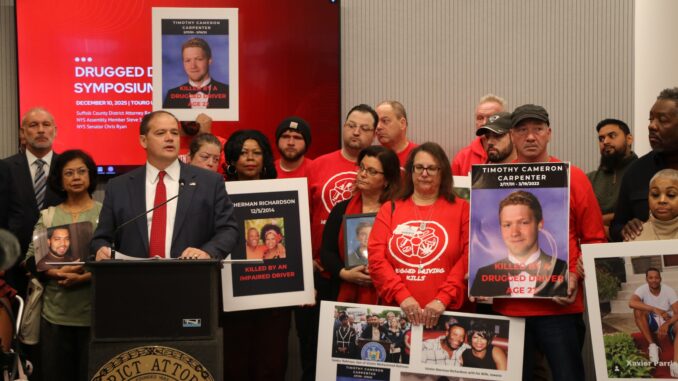
NEW YORK, NY — Suffolk County District Attorney Ray Tierney was joined by elected officials, prosecutors, advocates and victims’ families at a press conference on December 10 at Touro University, which was followed by a legislative symposium on drugged driving.
Tierney pointed out that New York State is one of four states in the country that “permits dangerously impaired people to drive legally” because the drugs that the driver has in their system are not considered to be illegal under the Public Health Law. That means, he said, drivers can drive while high on nitrous oxide, xyladine or other synthetic drugs.
“This loophole … allows impaired drivers … who operate vehicles and threaten the lives of citizens with impunity, no matter how impaired they may be,” Tierney said. “Innocent drivers and pedestrians are being injured and killed every day because of this loophole.”
New York State has “unwittingly opened this loophole” and “it’s finally time to close the loophole and come into the fold with other states,” he said. “Victims and their families deserve no less.”
Tierney also emphasized that this is a bipartisan issue, with state Assemblyman Keith Brown (R-Northport) and state Senator Monica Martinez (D-Brentwood) in attendance.
State Senator Christopher Ryan (D-Syracuse) also called for a close to the drugged driving loophole. “The limitations of our current laws do not reflect reality,” he said. “The law allows drivers to avoid accountability and we need to put an end to that.”
Ryan pointed out this is not about the criminalization of drugs, but rather about the need for additional enforcement and to provide police with the necessary tools to enforce these laws. “We have to start holding people accountable and responsible.”
Assemblyman Steve Stern (D-Dix Hills) thanked the police and prosecutors for “[jumping] out and [taking] such a strong leap on this critically important issue that have not only created an urgency locally but has resonated across the country.”
Stern viewed the photos held up by the families of those who were killed by drugged drivers and noted the importance of remembering those who died.
“If you look at the photographs, it doesn’t matter where they’ve been taken,” he said. “It could’ve been [taken] on any street corner. … It could be any one of us in this room. That it could be any one of our loved ones who has been impacted by this scourge.”
Closing the loophole “is about saving lives,” Stern said. “We owe the victims, we owe the families, we owe it to everyone who shares the road. We owe it to the officers and the prosecutors who are expected to protect us, but need the legal authority to do so effectively.
“It ensures common sense,” he continued. “We have to make sure no one operates a car impaired.”
“This is a statewide issue,” added Manhattan DA Alvin Bragg. “It’s not a Long Island issue, a Manhattan issue or an upstate issue. It’s a statewide issue.”
Darrin Grondel, the senior vice president of Traffic Safety at the Foundation For Advancing Alcohol Responsibility (FAAR), said it will take “a huge group” of individuals to work together and close the drugged driving loophole. He said this is about saving lives in more ways than one.
“It’s not about saving lives from crashes, it’s about saving lives from addiction,” Grondel said. “If we don’t have the information, we’ll see recidivism, we’ll see people with multiple DUIs … because the drug wasn’t on the list and the officer couldn’t identify the drug.”
Grondel said the legislation is “long overdue,” adding, “It is way too long to see this happening. Drugged and drunk driving is an ongoing epidemic that takes far too many lives across the United States. … We want to put New York back on the map on enforcing.”
Badrul Choudhury, whose father-in-law, Mahammed Rahman, was killed by a driver under the influence of drugs, spoke at the press conference. “None of the seven offspring or 18 grandchildren are here, not because they don’t love or respect Mr. Rahman, but because they lost hope,” he said. “However, I see hope, I see changes in the law and I am here so no family goes through what my family went through.”