

By Hank Russell
A local state senator recently introduced a bill with an assemblyman from a neighboring state that they said will keep law-abiding motorists from being socked with fees and administrative charges if they commit a rare traffic infraction.
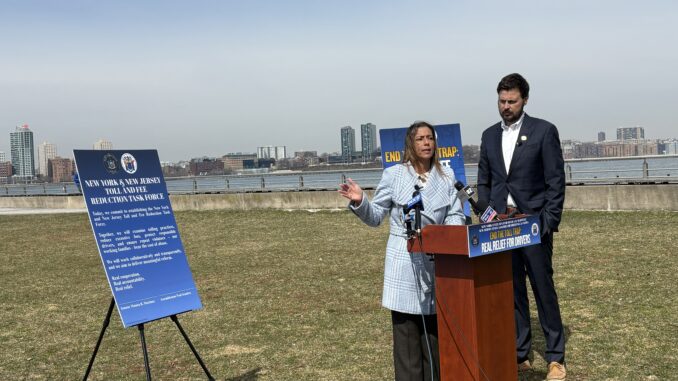
During a press conference held in front of the Hudson River, New York Senator. Monica R. Martinez (D-Brentwood) and New Jersey Assemblyman Paul Kanitra (R-Brick) recently introduced legislation in both states that would reduce excessive penalties and administrative fees charged by the Port Authority. The lawmakers say these toll enforcement reforms and other measures now pending in Albany and Trenton will save motorists across the greater New York Metropolitan area money.
Under the proposals, non-habitual toll violators who receive fewer than two violations within a 90-day period would only be liable for the toll due rather than the fee and an administrative charge. Currently, the Port Authority of New York and New Jersey adds a $50 administrative surcharge for E-ZPass toll violations or improperly mounted tags and forces those motorists enrolled in the electronic tolling program into a higher “Mid-Tier” rate for that violation. As a result, a two-axle passenger vehicle whose toll wasn’t collected through E-ZPass is charged as much as $66.79 for an infraction that should have been a $16.79 fee.
For vehicles that are cited more than two times within 90 days, the legislation requires that any administrative fee imposed be reasonable and tied to the actual cost of processing the toll violation.
“Drivers shouldn’t be forced to pay an administrative fee ‘toll troll’ when crossing between New York and New Jersey,” Martinez said. “Aggressive penalties have been hurting drivers, especially those who make the occasional error. Our legislation protects them and all motorists crossing the Hudson and will reduce the expense of traveling between our two states.”
This issue has affected millions of drivers across both states. Between July 2020 and July 2025, Kanitra said, motorists incurred more than seven million toll violations in New Jersey alone. According to New Jersey data, during that same period, the median violator received only two violation notices, and the average violator received less than four violation notices, suggesting that most impacted motorists are not chronic offenders, but ordinary motorists. These bills aim to correct the issue by shifting these fees away from everyday commuters who make occasional mistakes and onto habitual toll evaders.
“For too long, good New York and New Jersey drivers have had to pay ridiculous fines because of the actions of a few toll cheats,” Kanitra said. “I’m grateful to present this bi-state, bipartisan solution with my good friend Senator Martinez. I’m hopeful that members of both of our political parties will jump onto this and help us push it through.”
In addition to the administrative fee changes, the measures propose an annual reporting requirement for all toll collecting public authorities. The reports are intended to increase transparency and will be required to include information such as the number of toll violations issued, the frequency of violations by motorists, the amount of revenue collected from repeat violators, historical comparisons in violation rates, and the administrative cost of processing tolls and associated violations.
Finally, the proposals are calling for the creation of a bi-state advisory group to reduce tolling-related costs for drivers in New York and New Jersey. The 12-member “New York and New Jersey Toll and Fees Reduction Task Force,” as it will be known, will be tasked with evaluating current payment processing procedures and systems, and providing recommendations to increase efficiency and reduce tolls and administrative fees for motorists. Specific areas they will evaluate are:
- identifying inefficiencies in the tolling process and methods for reducing costs
- considering and providing recommendations for an amnesty program
- analyzing the impact of congestion pricing on motorists
- recommending methods for further shifting the cost burden of toll violation enforcement away from occasional or inadvertent violators and onto intentional toll evaders
Long Island Life & Politics reached out to the Port Authority for comment and is waiting to hear back.