

By Hank Russell
A local state assemblyman is calling on Governor Kathy Hochul to provide more money for Long Island’s roads, which he says are crumbling and in need of repair.
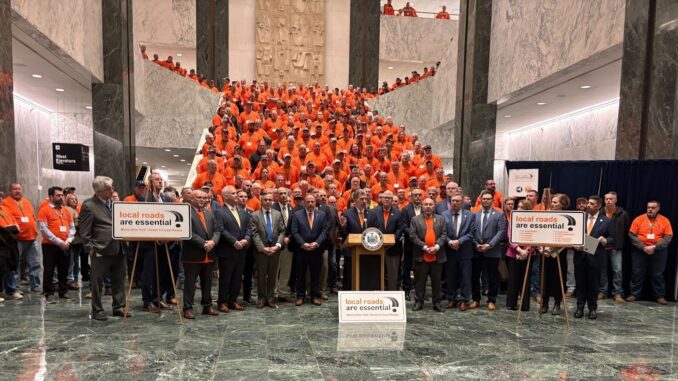
Keith Brown (R,C-Northport) joined colleagues from across the aisle in the Well of the Legislative Office Building on March 4 to urge the governor to include an additional $250 million in Consolidated Local Street and Highway Improvement Program (CHIPS) funding in this year’s state budget.
Brown said the increased investment is critical for communities on Long Island, where heavy traffic volume, coastal weather conditions and rising material costs are accelerating wear and tear on local roads.
“Long Island drivers already face some of the highest costs of living in the country. The last thing families need is crumbling roads and higher local taxes because Albany failed to properly fund infrastructure,” Brown said. “If we’re serious about affordability and public safety, we need to strengthen CHIPS funding now.”
CHIPS provides direct state aid to towns and villages for road and bridge maintenance. According to local highway officials, the cost of asphalt, concrete and fuel has surged in recent years, stretching municipal budgets thin and forcing difficult choices between delaying repairs or increasing property taxes.
Brown emphasized that proactive investment saves taxpayers money in the long run.
“It’s far less expensive to maintain a road than to completely reconstruct it,” Brown said. “By increasing CHIPS funding by $250 million, we can help local governments stay ahead of costly deterioration, improve safety for drivers and pedestrians, and protect taxpayers from bigger bills down the line.”
Brown added that infrastructure reliability is essential not only for residents’ daily commutes, but also for supporting small businesses and ensuring first responders can reach emergencies without delay.
“Our roads are the foundation of our local economy and our public safety network,” Brown said. “This is a practical, commonsense investment that delivers real value to Long Island communities.”
Brown is not the only elected official to call for more money and immediate repairs to local roads. As previously reported in Long Island Life & Politics, Suffolk County Legislator Nick Caracappa (C-Centereach) held a press conference demanding that the state repair the Middle Country Road (Route 25) corridor in the Selden-Centereach area as soon as possible. He cited LILP the potholes and safety concerns when making left-hand turns.
LILP also reported that Nassau County Executive Bruce Blakeman, Assemblymen Jarrett Gandolfo (R,C-Sayville) and Michael Durso (R-Massapequa Park) viewed a video that revealed a large hole in the roadway of the state-owned Fire Island Inlet Bridge. Gandolfo and Durso also noted that Long Island’s share of state transportation funding has fallen from nearly 24% historically to well under 15% today — even as vehicle registrations and travel demand continue to rise. In inflation-adjusted terms, state highway investment on Long Island has dropped by more than 50% from peak levels.
reached out to the state. A spokesperson for the New York State Department of Transportation said, “”New York State is investing more in the modernization of its transportation infrastructure than at any other point in the state’s history thanks to the historic $34.4 billion, five-year Capital Plan for the State Department of Transportation, which provided nearly $6.5 billion for local highway plans (an increase of 89% over the last five-year plan.) “
The spokesperson noted that Hochul’s proposed 2027 Executive Budget includes $6 billion for the fifth and final year of the Capital Plan, including $1.4 billion to improve local roads and bridges. “NYSDOT will also invest an additional $600 million in over 180 paving projects across the state, which when combined with the Department’s core paving programs, totals a nearly $1.2 billion investment that will resurface more than 4,000 lane miles.”