

Previously Published in The Messenger
By Matt Meduri
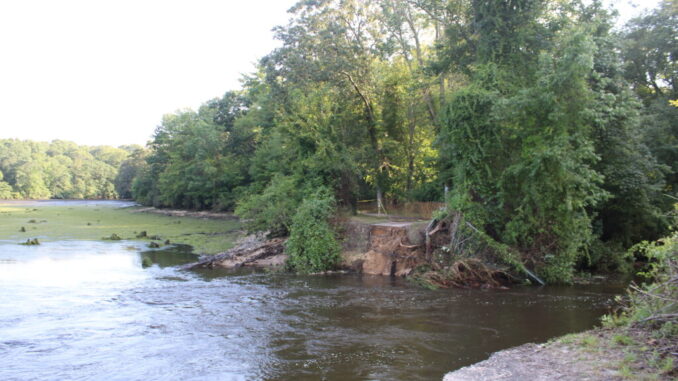
SMITHTOWN – Smithtown residents continue to reel over the loss of the beloved Stump Pond, which drained when the dam failed due to the torrential downpours brought by Hurricane Ernesto in August 2024.
But an ever-more salient issue now is that of whether or not the debate should be rebuilt.
Many in Smithtown are calling for the restoration of the town’s foremost hidden gem located in Blydenburgh County Park, which brought recreation, fishing, and a natural refuge amidst suburban sprawl. On the other hand, environmentalists are suggesting that nature take its course and that the Nissequogue River be permitted to flow at its heart’s desire.
The Messenger sat down with Suffolk County Executive Ed Romaine (R-Center Moriches) to get a comprehensive view of the issue.
Romaine, a former history teacher and eternal history buff, says that the dam was built in 1798 by Isaac Blydenburgh and two of the Smith boys. The trees were cut down to build the mill, leaving the stumps behind. The pond is also said to have been a fishing spot of Daniel Webster, the twice-served Secretary of State under Presidents William Henry Harrison and Millard Fillmore.
Public Safety and Recreation
“We’re living in times of extreme weather,” Romaine told The Messenger. “Do you think we’re not going to get nine inches again? What happens when we get nine inches of rain and there’s no dam to control the flooding? All of that’s going to go downstream [of the Nissequogue River] – the only river on Long Island that flows north.”
During Hurricane Ernesto, the water from Stump Pond flooded Jericho Turnpike, causing significant flooding damage to homes, roadways, and even Town Hall itself.
“The first things you worry about are public safety and property damage,” said Romaine. “The second thing is, this park is one of the widely-used parks right in the middle of populated areas. People are looking at this for recreation.”
Canoeing, kayaking, fishing, camping, horseback riding, and hiking are just a few of the activities to which Blydenburgh plays host, and Stump Pond greatly supported the allure of these amenities. Entrance to the park and activities, save for camping, are all free.
Indeed, camping spots are prevalent in Eastern Suffolk, as well as on Fire Island, primarily, while large, freshwater bodies don’t offer what Stump Pond did. Lake Ronkonkoma, for example, is too polluted to offer the recreational value that Stump Pond did.
Moreover, several people have gotten stuck in the quicksand-like mud flats that make up the barren pond bed. One individual required rescue via helicopter.
Environmental Debate
Debate quickly ensued, as environmental organizations descended on Smithtown to make their case heard. But their argument to let the river run free not only shirks the nuance of Stump Pond, but is part of a large, national, anti-dam sentiment.
“I’m supporting the reconstruction of the dam,” said Romaine, adding that the Suffolk County Legislature voted unanimously to fund testing of the site. The Suffolk County Council of Environmental Quality (CEQ) heard two rounds of testimony from the public, where support for rebuilding the dam was overwhelming. The CEQ voted almost unanimously in their finding that reconstruction of the dam would not have a significant negative impact on the environment.
“Most environmentalists feel this way about all rivers in the United States, that they should not be dammed,” said Romaine. “This [Stump Pond] dam didn’t produce power; this dam offered protection from downstream flooding. It created a water feature and we don’t have that many usable water features that are accessible to the public.”
Romaine also dismissed claims that the project isn’t getting the “review it deserves,” saying that the project has been under review for the last eighteen months.
The Suffolk County Legislature will then vote whether or not to approve the CEQ’s findings and start the process of obtaining permits from the State Department of Environmental Conservation (DEC).
“Many people opposed to it [rebuilding the dam] don’t live around here,” said Romaine, adding that his office has received a slew of emails, some of which are from bot accounts, that urge the County to take the positions of their respective environmental groups.
“In their hearts, they believe that trying to save the environment is the right thing. I get it; I’m an environmentalist. But I have to weigh this against public safety and adequate recreational facilities for a county this size, particularly on the West End,” said Romaine, crediting maintenance and renovations of Smithtown’s parks to Supervisor Ed Wehrheim (R-Kings Park).
Romaine said that while energy-generation components of a possible new dam aren’t actively being evaluated, he’s interested in doing a cost-benefit analysis of such an addition once the process of approvals and permitting is completed. A fish ladder is also on the table to perpetuate species of alewife and trout.
“There’s also supposed to be a drain mechanism just in case they need to relieve pressure. That’s a new safety design,” Deputy County Executive Jennifer Juengst told The Messenger. “It will certainly be built to DEC’s specifications. DEC said to not show them a dam design that’s not modern. That’s where the expenses come in.”
Of concerns raised for species of birds and plants that are now populating the area that would be harmed by reconstruction of the dam, Romaine says that they are misplaced.
“The dam was there for 228 years. It was never a problem. Now it’s a problem?” said Romaine. “How’s it going to be different if we build a dam, except the dam is going to be more efficient, modern, will have a fish ladder, and a drainage system. What did you [environmentalist] do for 228 years? You never voiced one complaint. If it’s such a crisis now, how come the flora and fauna survived?”
Romaine says that if rebuilding the dam would have such a negative environmental impact, then the H. Lee Dennison Building in Hauppauge, built directly atop the headwaters of the Nissequogue River, might as well be demolished.
“Should we knock down the Dennison Building and let the creeks go wild? What about Veterans Highway (NY-454)? Do we need to build a huge culvert so we have a bridge?” asked Romaine. “We have to engineer for today’s world.”
“We would have flooding on NY-25/25A by the Bull. There’s a lot of development along both banks of the Nissequogue River. I don’t think those residents would be too happy,” said Juengst.
“I admire them for their commitment to the environment, but they’re proposing something that is not realistic,” said Romaine.
Suffolk County Legislator Leslie Kennedy (R-Nesconset), whose district includes Blydenburgh, agrees.
“Normally, I am a purist when it comes to environmental projects, but we need (pictured right) told The Messenger.
What They’re Saying
The Forestwood Civic Association, led by President Bob Sikora, has led the charge in gauging public opinion since the dam broke almost two years ago.
“We had over 200 people show up to that first meeting in September 2024. 98% of them were in favor of rebuilding the dam and the pond,” Sikora told The Messenger. “It’s a historic park. There were always kids riding their bicycles around the pond, people horseback riding, and hiking. There aren’t many places like this in Suffolk County. It’s a gem, even for the rest of Suffolk.”
Sikora adds that environmental opposition to the dam is “misplaced.”
“I was there in October. It’s not a ‘raging river;’ it’s a little stream,” said Sikora. “There’s hardly any water fowl there now and all the vegetation in the pond bed are invasive species.”
Sikora also supports engineers’ plans to create a modern, concrete dam to withstand erosion and torrential rainfall.
Jim Jouke, President of Long Island Bassmasters, a long-standing fishing club, has launched outdoorvoicesli.com to lobby for the restoration of Stump Pond.
“We’re working with other partners and organizations to try to get it built as fast and as smooth as possible,” Jouke told The Messenger. “The pond is important to everyone, not just to the fishers, but the hikers, kayakers, equestrians, and all outdoors people looking to get this park back to what it was.”
Jouke says that Stump Pond was “one of the better” fishing locations on Long Island. The Long Island Bassmasters had held almost thirty years worth of events. The most recent was the Father’s Day event where fathers could take their kids to fish on the pond in the morning before family festivities. It was the last event held by the Bassmasters before the dam collapsed.
“I think the environmentalists [opposed to the dam] have a lot of backing and funding from large, national organizations,” said Jouke. “ They’re trying to focus on getting what their followers want, while we’re working with local Smithtown residents who use the pond every year for recreational purposes. It’s a shame.”