

Murray: ‘Let’s Get Justice for Sarah’
By Hank Russell
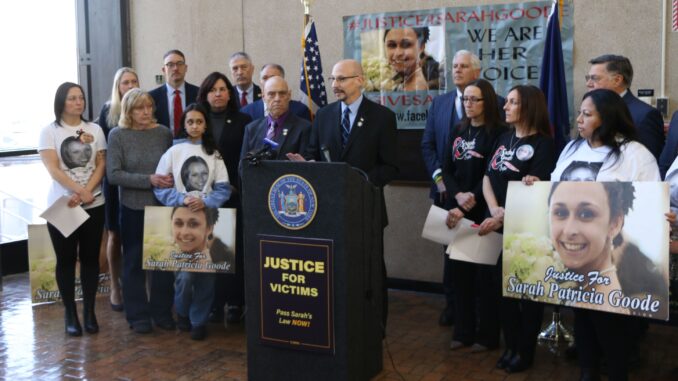
Local elected officials gathered at the Perry Duryea State Office Building in Hauppaugue on January 30 to introduce a bill that would reinstate the conviction of a crime, even if the offender dies in prison while an appellate court reviews the case.
State Senator Dean Murray (R-Patchogue) and Assemblyman Joe DeStefano (R-Medford) announced they are introducing Sarah’s Law, named after Sarah Patricia Goode. The bill would close a loophole in state law that allows criminal convictions to be vacated if a defendant dies while an appeal is pending.
In 2016, a Suffolk County jury convicted Dante Taylor of second- and first-degree murder and attempted rape after he brutally stabbed Goode 42 times and left her body in the woods. He was sentenced to life in prison without parole. However, after Taylor died while appealing his conviction, New York law required that his conviction be dismissed, leaving no one legally convicted of Goode’s murder.
Murray said his legislation would do away with the “antiquated” legal doctrine of abatement ab initio, which currently permits convictions to be erased without appellate review, even after a jury has delivered a guilty verdict.
“New York does a horrible, horrible job when it comes to crime victims,” Murray said. “They are the most forgotten people in this state. … When we pass these pro-criminal laws, there’s no thought given to the victims.”
Murray said he has met with crime victims and their families to see “what we can do better for them and what they have been through. We have heard a lot of poignant things. But the one thing that jumped out at me … was abatement ab initio.”
This was used in the case of Aaron Hernandez, according to Murray. Hernandez, a former member of the NFL’s New England Patriots, who was sentenced to jail in 2015 for the 2013 murder of Odin Lloyd. Two years later, Hernandez committed suicide by hanging himself in his jail cell and the conviction was subsequently erased.
“Some states ignore [abatement ab initio] altogether,” Murray said. “That is something we should do.” He mentioned that Massachusetts, considered to be a “progressive” state, noted that the loophole “goes too far.”
As for Taylor, Murray said, his conviction has been erased. “If you look up to see how Sarah Goode died, you will not see his name there. … He had his day in court.”
Murray pointed out that the bill has “purposeful language” allowing the Suffolk County district attorney to reinstate Taylor’s conviction, which was greeted with applause.
DeStefano said the legislation “goes to the heart of justice and accountability. Allowing a guilty verdict to disappear undermines confidence in the justice system and sends a devastating message to crime victims and their families.”
The proposed legislation “stands for fairness, finality and respect,” DeStefano said. “It ensures that the truth is preserved and that accountability is not undone after the fact. It also ensures families are not forced to relive the trauma. The bill is not about punishment, relitigation or cutting corners; it’s about standing with victims and making sure the system stands for them, not against them.”
“This law is a law that offers justice for the victims and the victims’ families, it’s as simple as that,” added Suffolk County Executive Ed Romaine. “Someone who commits a crime and is convicted by a jury of their peers should not, even after their death, have their convictions erased.”
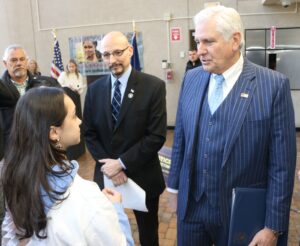
Nassau County Executive Bruce Blakeman also spoke at the press conference. “This beautiful family had to sit through a trial, had to endure all the publicity while they were grieving,” he said, adding the case went through the entire legal process, “only to have it stolen away by one of our ridiculous laws that protect criminals rather than victims. We have too many laws like that in the state of New York.”
“When our state cares more about our criminals rather than our victims … we should be thinking about the victims of crimes and their families,” Blakeman continued. “A life was taken away in the most disgusting and heinous act. … I truly hope that [the state Legislature] will have the guts and the fortitude to pass this law, to right this injustice and to make sure that no more injustices and pain [occur] in this state.”
Goode’s sisters later came up to speak. Jennifer Driver referred to her sister’s killer as “a coward” by “choosing to take his own life.” She said the abatement gave the impression that “the crime never happened and Sarah’s life never mattered. The facts did not disappear, the facts did not change, the jury verdict did not vanish, yet this doctrine allowed the verdict to be erased and our families to be revictimized all over again.”
The doctrine “did not just erase justice,” Driver said, “it erased accountability. … We will not stop fighting for justice. New York State must get rid of this antiquated law. This bill must pass. Sarah’s life mattered and will always matter and the law should reflect that.”
Tabatha Miller recalled Goode as being “the sweetest, silliest, kindest 21-year-old girl you’ll ever meet.” She recalled that day when ”everything was taken away from [Goode’s] mom, her daughter and us” and how the “antiquated, outdated” doctrine allowed Taylor’s conviction to be erased.”
She called on the state Legislature to not only remember the crime victims but “the secondary victims,” meaning the victims’ families. She also said “Massachusetts had a brain” when they reinstated Hernandez’ conviction and called on New York to repeal the abatement. “That’s the only logical thing to do. Think about the victims for once.”
Elizabeth DiMurra said the verdict “disappeared in invisible ink and signed in blood in 2016,” quoting Judge John B. Collins. “Those words were supposed to mean something,” DiMurra said. “They were supposed to be permanent, but now, those words mean nothing.”
On January 2018, the state “decided it was more convenient to side with the criminals than to challenge the antiquated doctrine. … Id justice can be undone so easily, idf everything that the criminal justice system stands for can be undone by an antiquated doctrine, not even a law, then the entire criminal justice system is compromised.”
DiMurra said this not only affects her sister’s case but also other murder cases as well. “It also tells the victim that the system will protect the murderers, rapists, pedophiles and other horrendous criminals over the truth.”
She also asked the lawmakers in Albany, “Which lawmaker is going to look at my mom and Sarah’s daughter Jocelyn in the eye and tell them her mom and her life weren’t worth fighting for? Who wants to tell them that? But it’s OK to protect a criminal and wipe his charges out so his family can benefit. Who can explain why a convicted criminal deserves a clean slate but Sarah did not deserve permanent justice? Are you willing to say that when the bill comes before you?”
DiMurra said Sarah’s Law “is not a political issue, it’s a human one. We need to bring everyone together and support this bill. Each day that goes by without passing this bill retraumatizes victims, our families and our daughter Jocelyn, knowing that our lawmakers who deny this bill think a murderer’s life is more important than [Goode’s] life.”
The bill is Goode’s “legacy,” DiMurra said, “She will continue to help people” victimized by such crimes “even after she’s gone. … We will not stop until we get justice.”
Murray concluded, “Let’s get justice for Sarah.”