

This article has been updated with a quote from Assemblyman Keith Brown.
By Hank Russell
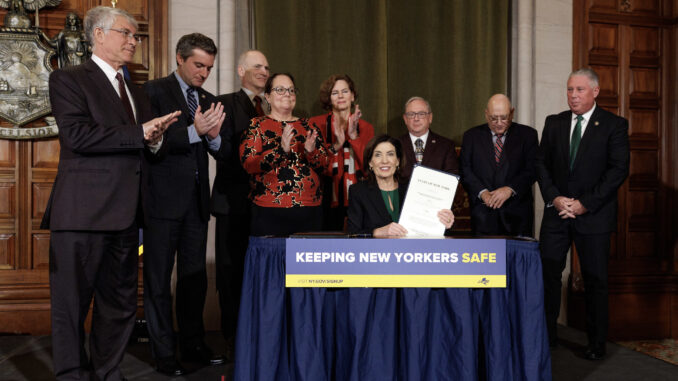
Governor Kathy Hochul signed two pieces of legislation on December 22 that she said will protect New Yorkers from the harmful effects of kratom, a commercially available herbal product sold for recreational use. This comes amid a rise in concerns about the link to potential health risks.
Hochul signed legislation sponsored by state Senator Patricia Fahy (D,WF-Amsterdam) and Assemblyman John T. McDonald III (D-Albany) that amends public health law to prohibit the sale of kratom products to individuals under 21 years of age. Local cosponsors included state Senators Steven Rhoads (R-Levittown) and Alexis Weik (R-Sayville) and Assemblymembers Ed Ra (R-Massapequa Park), Judy Griffin (D-Rockville Centre), David G. McDonough (R-Bellmore), Michael Durso (R-Massapequa Park), Phil Ramos (D-Brentwood), Keith Brown (R,C-Northport), Joe DeStefano (R-Medford) and Daniel Norber (R,C-Great Neck).
In addition, the new law will prohibit sales of kratom to persons under the age of 21. Under this legislation, anyone selling kratom to individuals under 21 years of age can face a fine of up to $500 for each offense.
Another bill signed by Hochul requires any kratom product being manufactured, distributed or sold in New York State to include a consumer warning label. The Senate version was introduced by James Koufis (D-Corwall) with Rhoads and Weik among some of the cosponsors. Phil Steck (D-Schenectady) sponsored the Assembly version; Brown and Griffin cosponsored the bill, among others.
The legislation will require any kratom product to include a full list of ingredients as well as a consumer warning that the product may be addictive and may interact with certain medications, drugs and controlled substances.
“Kratom is a commercial substance that is commonly labeled an “all-natural herb”, leading people to believe it’s completely safe — but the reality is it can be extremely dangerous and unfortunately, in some cases, lethal,” Hochul said. “No parent in New York should have to endure the loss of a child to a substance simply because they didn’t know what was in it. This legislation ensures transparency and strengthens our public health laws so that information about the ingredients and potential harmful risks associated with kratom are clear.”
“This legislation is about protecting kids and making sure families aren’t left in the dark about what’s being sold over the counter,” Brown said. “Kratom has been marketed as a harmless, ‘all-natural’ product, but the reality is that it carries serious health risks, especially for young people. Setting an age limit and requiring transparent labeling are common-sense safeguards that put public health first. Parents deserve to know that products sold in local stores won’t put their children at risk,” Brown added. “This bipartisan effort strikes the right balance, protecting minors, improving transparency and giving New Yorkers the information they need to make informed decisions.”
Kratom is an herb from Southeast Asia that may be used for its stimulant and analgesic effects, according to the New York State Department of Health. The substance is often taken as an energy booster, mood lifter, pain reliever or recreationally. Some consumers also report using kratom to relieve symptoms of withdrawal from opioids.
While kratom itself is not an opioid, when taken in larger quantities, it can act in a way similar to other opioids, leading to tolerance, physical dependence and withdrawal symptoms. In some rare cases, deaths have been associated with kratom use, though in these cases kratom was usually used in combination with other substances, including fentanyl, other synthetic opioids, benzodiazepines, stimulants, alcohol, anti-convulsants and other medications.
The U.S. Food and Drug Administration has issued safety concerns regarding kratom, including liver toxicity, seizures, and substance use disorder. The State Department of Health has developed information about best clinical practices for clinicians.
A minor natural component of kratom, 7-hydroxymitragynine (7-OH), can have a strong opioid effect when in concentrated form. Manufacturers have made synthetic 7-OH (which may be sold as 7-OH or added to kratom plant products) in substantially higher quantities than would be found in unadulterated kratom. Research about 7-OH and its potential association with dependence or overdose is ongoing. The New York State Department of Health began to specifically monitor 7-OH in June 2025.
“Kratom has the potential to create dependency and can also cause liver toxicity, seizures and other health conditions,” Dr. James McDonald, the state’s health commissioner, said. “The Department remains committed to keeping New Yorkers informed as new information about kratom emerges.”
Office of Addiction Services and Supports Commissioner Dr. Chinazo Cunningham said, “Kratom can cause severe health problems, including in some cases, interactions with other substances that may lead to death. This legislation will protect children from the harmful effects of this substance, and will ensure that individuals know what is in the products they’re buying, allowing them to make informed decisions to keep themselves safe.”
Because kratom is not regulated at the federal level, nor approved by the FDA, the safety and efficacy of the product have not been established. New Yorkers are encouraged to contact Poison Control with a health concern linked to the use of kratom sold in the state, or call 911 in case of emergency.
New Yorkers struggling with an addiction, or whose loved ones are struggling, can find help and hope by calling the state’s toll-free, 24-hour, 7-day-a-week HOPEline at 1-877-8-HOPENY (1-877-846-7369) or by texting HOPENY (Short Code 467369). Available addiction treatment including crisis/detox, inpatient, residential, or outpatient care can be found on the NYS OASAS website.