

By Hank Russell
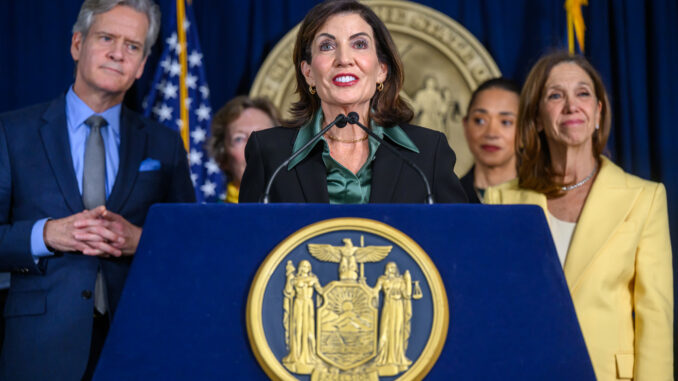
In what was considered to be the most controversial decision she has made as governor, Kathy Hochul announced an agreement with the Legislature on December 17 to make medical aid in dying available to terminally ill New Yorkers with less than six months to live.
Hochul said this comes after careful reflection and deliberation with the bill’s sponsors — state Senator Brad Hoylman-Sigal (D, WF-Manhattan) and Assemblymember Amy Paulin (D-Scarsdale) — advocacy organizations, and most importantly, everyday New Yorkers who shared personal experiences with her. The bill, with the agreed-upon amendments, will be passed and signed in January, and the law will go into effect six months later.
“New York has long been a beacon of freedom, and now it is time we extend that freedom to terminally ill New Yorkers who want the right to die comfortably and on their own terms,” Hochul said. “My mother died of ALS, and I am all too familiar with the pain of seeing someone you love suffer and being powerless to stop it. Although this was an incredibly difficult decision, I ultimately determined that with the additional guardrails agreed upon with the legislature, this bill would allow New Yorkers to suffer less–to shorten not their lives, but their deaths.”
The bill, as passed by the Legislature, had a number of protections in place to ensure that no patient was coerced into utilizing medical aid in dying and no doctor or religiously affiliated health facility was forced to offer medical aid in dying. With the most recent agreement, Hochul announced a number of additional guardrails that the Legislature has agreed to enact aimed at ensuring the integrity of the patient’s decision and the preparedness of medical institutions to appropriately administer medical aid in dying. Today’s agreement memorializes a shared path forward on this bill, with additional key guardrails, including:
- a mandatory waiting period of five days between when a prescription is written and filled.
- an oral request by the patient for medical aid in dying must be recorded by video or audio.
- a mandatory mental health evaluation of the patient seeking medical aid in dying by a psychologist or psychiatrist.
- a prohibition against anyone who may benefit financially from the death of a patient from being eligible to serve as a witness to the oral request or an interpreter for the patient.
- limiting the availability of medical aid in dying to New York residents.
- requiring that the initial evaluation of a patient by a physician be in person.
- allowing religiously-oriented home hospice providers to opt out of offering medical aid in dying.
- ensuring that a violation of the law is defined as professional misconduct under the Education Law.
- extending the effective date of the bill to six months after signing to allow the Department of Health to put into place regulations required to implement the law while also ensuring that health care facilities can properly prepare and train staff for compliance.
“This law will represent the culmination of more than 10 years of determined, consistent effort by hundreds, no, thousands, of New Yorkers who advocated for this law,” said Corinne Carey, the senior campaign director for Compassion & Choices NY/NJ. “I’ve had and continue to have the honor of walking alongside New Yorkers who faced terminal diagnoses with bravery and love — people who opened their homes, their hearts, and often their final months to this movement. Many did not live to see this day. We carry the memory of 29 advocates we lost along the way whose suffering might have been eased had this option been available.”
However, “the work cannot stop now,” said EOLCNY Executive Director Mandi Zucker. “We need to engage in a massive educational effort for physicians, attorneys, nurses, pharmacists, doulas, and so many other professionals who will be immediately impacted by this new law, as well as the general public. We look forward to working with the Governor’s office and many professional organizations in the coming months and years to ensure the law is implemented successfully and efficiently.”
One assemblymember who supported the bill was Charles Lavine (D-Glen Cove), who told Long Island Life & Politics, “Governor Hochul is courageous and thoughtful.”
While there have been supporters of this legislation, there have been detractors as well.
“I am deeply disappointed by the governor’s decision to sign the Medical Aid in Dying Act into law,” said Assemblymember Keith Brown (R.C-Northport). “This legislation represents a troubling shift in how New York approaches end-of-life care by legalizing assisted suicide rather than prioritizing compassion, treatment and support. With access to hospice and palliative care still uneven across our state, this law risks leaving vulnerable patients, particularly seniors, people with disabilities and those in underserved communities, with fewer real choices, not more.”
“There are no amendments to the MAID legislation that can make it palatable,” the Long Island Coalition for Life said in a statement. “There’s no place, on ethical and human dignity grounds, for state-sponsored suicide as treatment for those with suicidal ideation.”
Assemblymember Jodi Giglio (R-Riverhead) said Hochul’s signing of the bill “raises serious concerns” within her district, which, she said, is comprised of senior citizens, veterans and the disabled and caregivers.
“[They] want reassurance that New York will protect them and not create new risks at the most vulnerable moments of their lives,” Giglio said.
Matt Vallière, President and Executive Director of the Patients’ Rights Action Fund, said the amendments to MAID “to protect people who deserve care and support from the state and their medical teams,” adding, “There is no true accountability to protect patients from potential harm, abuse, or coercion.”
During the press conference, Hochul addressed this. “No one has to do this. It’s a choice, but a choice that is made in a situation that no other state is asking for. You need to know this — need to know. I needed to know that when I heard voices of some who feared duress, that there would be someone who was tired of taking care of someone, someone with a disability or someone who was elderly and just said, ‘I can’t do it anymore.’
Hochul admitted that “there could be coercion, duress, and pressure put on people. And I was concerned about that . … Everyone will know that someone who makes that decision did it of free will, not under pressure. And so, those are some of the constraints I put around this.”
According to Vallière, there was no public hearing on this bill and the state Legislature has not held a hearing on assisted suicide bills in the past seven years. He also argued that the bill violates the Americans with Disabilities Act and emphasized that his organization “will continue to oppose these unjust laws.”
“New York should be expanding access to quality end-of-life care and strengthening protections for the vulnerable,” Brown said, “not normalizing the end of life as a policy response to suffering.”