

Previously Published in The Messenger
By Matt Meduri
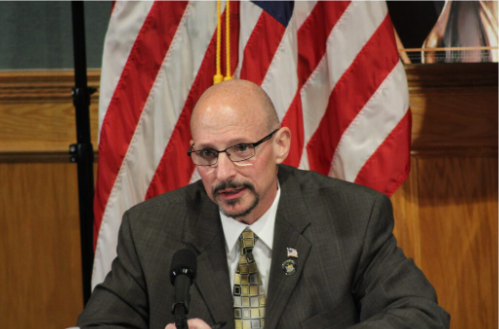
Last week, Senator Dean Murray (R-East Patchogue), along with members of the Senate Republican Conference, held a roundtable to not only discuss officials’ perspectives on New York’s crime, but also to allow the victims to discuss how the system has impacted them.
Senator Murray was joined by Senators Mario Mattera (R-St. James), Steve Rhoads (R-Bellmore), and Rob Rolison (R-Poughkeepsie).
“We need to hear from the experts, but more importantly, we need to hear from the crime victims and the loved ones and family members of crime victims,” said Murray, adding that such victims are “the most forgotten people in New York State.”
“We don’t do nearly enough for those who have been victimized,” said Murray, a member of the Senate Crime Victims, Crime, and Correction Committee.
An additional purpose of the roundtable was to field experience from victims and professionals alike to craft legislation in the upcoming session in Albany, which kicks off in January.
Senator Rolison owes his experience to twelve years as a police officer in Poughkeepsie, followed by fourteen years as a detective. In that time, he saw the “evolution of policing”, as well as the “evolution” of crime victims are dealt with. Rolison currently serves as Ranking Member of the Senate Crime Victims, Crime, and Correction Committee.
“Being a crime victim is often the loneliest place you can be,” said Rolison. “You never really get away from that.”
Senator Rhoads connects the “dramatic shift” in New York’s handling of crime to the reforms in 2019, which promulgated cashless bail. In that process, he said there were “no real consultations with law enforcement, few consultations with district attorneys, certainly no consultations with the victims of crime.”
Rhoads is crafting Senate Bill 7296, which would be the spiritual successor to a program he created while serving on the Nassau County Legislature. It would form a statewide Office of Crime Victim Advocate, which would assign counsel to represent the victim of crime to fight for their rights.
Prosecutorial Perspectives
Representing the prosecutorial angle of the problem, Suffolk County District Attorney Ray Tierney (R) and Deputy Bureau Chief Daryl Levy, of the Nassau County D.A.’s Major Offense Bureau, were on hand.
Suffolk D.A. Tierney said that one of the biggest “sea changes” he’s seen since becoming an attorney in 1992 was that “victims didn’t have an absolute right to speak at the sentencing of defendants.”
“In many instances, the criminal justice system and some of the recent legislation has become antagonistic to victims,” said Tierney. “A lot of it has to do with accountability. If victims and victims’ families are not satisfied with the way things are, who can they hold accountable?”
Tierney started with the current diversion system, a process in which defendants – often first-time or non-violent offenders – are diverted away from the court system to an alternative program, such as rehabilitation, counseling, community service, etc. While Tierney said he’s not against diversion “where appropriate”, but the narcotics sector of criminal justice has “judicially mandated diversion.”
Tierney said that while victims and victims’ families have classical recourse through the voting process, which is traditionally strong enough counterbalance to poor policy, the mandates come from the State.
“If someone sells a quantity of fentanyl that they know has killed people in the past, he now gets diversion. All he has to do is go through counseling and he gets out with no jail time – and it’s mandated by the courts,” said Tierney. “You can’t complain to me; I can’t do anything about it. There’s no one to complain to.”
Tierney likened the diversion mandates to cashless bail, a scenario in which State law removes local control of judicial discretion and thereby removes crime victims’ from having an effective voice on the local level.
“The ability of local jurisdictions to set their public safety agenda is compromised because the so-called experts in the state are saying ‘this is what bail requires in Suffolk County,’” said Tierney.
Tierney also said that parole hearings themselves are handled differently than in previous years, particularly pertaining to the victims.
“You’ll have parole hearings and because of the lack of [victim or victims’ families] notification, the prosecutor’s office isn’t letting people know what’s going on,” said Tierney. “It’s antagonism towards victims and a lack of accountability.”
Tierney also took a swipe at the Domestic Violence Survivors Act, State law passed in 2019 that gives judges the discretion to lower sentences of defendants who survived domestic abuse and/or violence, as long as that violence was a significant contributing factor to their offense. The law carries a maximum penalty of five years for misdemeanors or felonies if it is determined that abuse contributed to the offense.
“If a person’s mom never hugged him and he’s angry about that, he goes out and shoots his neighbor who never did a darn thing to him,” said Tierney. “If he could establish that abuse, he does five years. And that’s not a decision that I [as D.A] make. It’s an abomination.”
Finally, Tierney mentioned Raise the Age, which allows juveniles convicted of crimes to be processed through family court, where punishments are “nonexistent.”
“The drivers of violence are now children, and we’re losing these cases where we would be holding these people accountable for years on end,” said Tierney. “It’s an incentive for criminal organizations to utilize children. That’s when you know you have a broken system.”
Chief Levy added that his training taught him that “victims are the most important part” of the job.
“They [victims] are the reason we do our job, the reason this system continues,” said Levy. “I think that young attorneys and assistant district attorneys (ADAs) don’t know how to connect with victims. They don’t know how to talk to them like normal human beings. They lose that connection because they’re so overwhelmed with discovery laws, bail issues, and them asking, ‘why isn’t the [state] legislature doing anything for us?’”
He added that victims must feel they’re being taken seriously by law enforcement, lest prosecutors lose the cooperation they might need to mount a case.
“They’re not going to trust you, the system, or the judges; they’ll think you don’t care. People want to be heard, not placated,” said Levy. “New York really is leaning towards the accused. Once somebody is charged, their rights matter, but [it should] not [be] to the detriment of everybody else.”
Law Enforcement Lessons
Representing law enforcement, Suffolk Police Commissioner Kevin Catalina and Nassau Police Commissioner Patrick Ryder shared their perspectives in conjunction with Suffolk PBA Treasurer CJ Hutter and Nassau PBA Second Vice President Frank Arcuri.
“The officers feel frustrated because they’ll arrest someone and two hours later, that guy’s out on the street, and they’ll do the same thing,” said Arcuri.
“There’s obvious frustration from the victims, but for the police officers responding too, how many times do they have to deal with the same thing over and over again?” said Hutter. “At what point are we going to make it where there’s consequences for actions and there’s real deterrence from committing the same behavior over and over again?”
SCPD Commissioner Catalina said that while recruitment problems in Suffolk aren’t to the same degree they are in Nassau or NYC, the incarceration rates between New York’s landmark criminal justice reforms and today are noticeable.
“When I started in the Suffolk County Sheriff’s Office in 2018, there were about 1,800 inmates. Now, there are around 1,100. There’s 700 people who are out on the streets who are not where they probably should be,” said Catalina. “That demographic are oftentimes the repeat offenders.”
Catalina added that many repeat offenders would probably benefit from incarceration and the programs to obtain sobriety and trade skills. He also said that the laws give the impression that the police aren’t doing their jobs.
“We had the ability back then to work with the court system and the judges to keep that person on bail if they were a repeat offender with a horrific record. We can’t do that anymore,” said Catalina (pictured right). “I can’t count how many families of victims who said, ‘Thank God they’re where they need to be right now [jail].’ The system has been created to no longer protect the victim and to make the cop fail.”
NCPD Commissioner Ryder said, “we learn nothing about the revolving door,” adding that unfunded mandates fall on the backs of localities, who then have to pull funding from officers on the street to keep up with Albany’s quotas.
The commissioners said that more funding should be allocated to services, such as social work and victims’ advocacy.
Advocates’ Advice
Representing the side of victim support were Laura Ahearn, Esq., Executive Director of the Crime Victims Center, and Wendy Linsalata, Executive Director of L.I. Against Domestic Violence.
Ahearn recounted the harrowing case of a Delaware County murder, in which a father stabbed his pregnant wife in front of their two young daughters, ages 7 and 9. His motive: he wanted a son and his wife was pregnant with another girl.
The two girls ended up on Long Island at the Crime Victims Center for resources, clothing, housing, and school district placement – as the nine-year-old daughter could only read at a kindergarten level. Legal advocacy also followed, with a lawyer working the case pro bono. Ahearn’s concerns for victims’ rights are that the Delaware County Police are not allowing the victim’s father to obtain the 911 call tape.
Ahearn says that while her center’s services were able to step up to the plate, the same can’t be said for other parts of the state.
“Every region should have the ability to mobilize immediately,” said Ahearn, calling for a regional homicide victim services coordinator to be appointed.
Ahearn slammed the parole reform, as every eighteen months, the victims and families of victims must “launch a campaign” to keep the offender behind bars.
“Our recommendation is to change parole eligibility hearing dates to every four years,” said Ahearn.
Linsalata, who worked with Senator Monica Martinez (D-Brentwood) to pass New York’s revenge porn reforms, is calling, along with Ahearn, for expanded protections against the mere threats of non-consensual dissemination of pornography. Ahearn also suggested a better alert system for orders of protection when they’re issued, especially within the family court system, and a more comprehensive rape crisis training program directly from the State Department of Health (DOH). Ahearn also called for plea reform.
“There’s 130 offenses for sex crimes. Endangering the welfare of a child is not a sex crime, but offenders will plead down to Endangering the Welfare of a Child, which is not a registrable sex offense under NYS Law,” said Ahearn.
Linsalata said that her organization is “underfunded”, adding, “health agencies like ours continue to provide immediate services to those whose lives are in danger. We need to have the staff on the ground to do that.”
Linsalata also said that the parole reform is playing out before her very eyes, as well as that of the victim in question.
“The defendant was sentenced to a rather short period of time on multiple attempted murder charges, multiple criminal contempt charges, and two assault charges. The sentence alone was not long enough; however, he was released early because of the reform,” said Linsalata. She added that while the victim is already battling permanent disability and PTSD, her defendant “getting out early made her feel like her life doesn’t really matter.”
Linsalata also suggested broader reforms to GPS tracking, as parole officers don’t track movements overnight.
“Prosecutors are asking for bail, stronger orders issued at arraignments, and GPS monitoring upon release. They’re being denied every day,” said Linsalata.
“It’s almost impossible to move anything that is related to crime and protecting the community out of the [State] Assembly,” said Ahearn. “It is the greatest betrayal we’ve seen in this state. We saw more positive legislation passing under Governor [George] Pataki (R) than we did in the history of this fine state.”
Ahearn added that federally funded agencies like hers were told from the federal level to “prepare survivors” to understand that their offenders may get out of jail early, essentially being required to normalize those cases and desensitize victims to them.
Linsalata said that her agency is working to make the welfare of pets a priority; she complimented the Nassau and Suffolk PDs on taking animal abuse cases seriously, but says that the gap needs to be bridged.
“A pet is a member of the family. When there is domestic violence, animals in the home are in danger. Anybody who is abusing or harming an animal is a threat to society in general,” said Linsalata.
The Victims Share Their Stories
Alisa and John McMorris have been perhaps the foremost advocates for criminal justice reform in New York. Their twelve-year-old son, Andrew, was hit and killed by a drunk driver while on a Boy Scout hike.
“When we sat in that courtroom, it felt like we were sucker-punched. We did not feel like victims; we felt second-class,” said Alisa McMorris of the loopholes and technicalities that complicate a judicial proceeding. “It felt like the system was built for everyone except us – the victims.”
McMorris criticized the State Legislature’s classification of an aggravated vehicular homicide as a nonviolent crime, saying, “I assure you that being struck by a 4,000-pound vehicle is violent.” That classification is what led to her remedy, aptly named “Andrew’s Law.”
McMorris also lamented the lack of substantive action after rallies, press conferences, and campaigns.
“I’ve walked the halls of Albany, I’ve walked nationally. Everyone’s really sympathetic. It ends with a beautiful handshake, but there’s nothing next. I’m really tired of hearing all the explanations. All they sound like are excuses,” said McMorris. “This crime should be treated no differently than if there was a loaded gun.”
Theresa Bliss lost her son, David, 25, to a broad-daylight murder in Port Jefferson. David’s shooter was under active probation supervision for his stabbing of a minor as part of a gang initiation just eighteen months prior. The shooter was initially charged with Assault in the Second Degree, a violent felony, but the charges were pled down to Assault in the Third Degree, a misdemeanor. The court issued probation over incarceration. During probation, the shooter built ghost guns, regularly carried a loaded handgun, and made frequent use of marijuana – “all clear violations of supervision conditions”, according to Bliss.
“We experienced failures that have significantly compounded our trauma,” said Bliss, adding that Suffolk Police on scene would not disseminate details to her. Bliss instead barnstormed all area hospitals before descending on the Sixth Precinct. She was told to wait in her car and only realized her son had passed away until a local news outlet reported the story.
“His family knew my child was vaguely shot before we ever got a phone call from anyone. We didn’t even know what hospital he was brought to, or if he was even brought to one,” said Bliss. “This is the failure of ethics, human decency, and respect. I was robbed of the chance to say goodbye to my son.”
Bliss added that the family would later learn that a detective had been sitting with David’s body at the hospital, but no calls were ever made to his family.
“This is about acknowledging that police cannot simultaneously run an active crime scene and provide emotional, informational, and logistical support that traumatized families desperately need in those first critical hours,” said Bliss. “Precincts need trained, on-call victim liaisons, people whose sole role is to communicate with families and hospitals while law enforcement handles the investigation. Families should never be left alone to piece together their own tragedy.”
Bliss called for survivors of non-domestic homicide and their families to have access to the levels of systemic review, transparency, and accountability that the State Domestic Violence Fatality Review Team does.
“The State loses the opportunity to learn where the systems fail,” said Bliss. “Every homicide, not just domestic violence, deserves the same level of examination, accountability, and prevention.”