
By Hank Russell
The Citizens Budget Commission (CBC) recently released a report showing how the Metropolitan Transportation Authority (MTA) can save approximately $2.5 billion a year through more efficient procedures, employee attrition and increasing contributions to healthcare benefits.
In its report “The Next Stop for MTA Efficiency,” the CBC noted that the MTA is facing budget gaps in the coming years — $295 million next year, $507 million in 2028, $707 million in 2029, and $897 million in 2030. :Notably, these gaps would have been larger had the MTA not increased its operating efficiency over the past several years, which the MTA reports saves more than $576 million annually,” the CBC said.
The organization said that the MTA could save $971 million alone through making maintenance improvements to its subway facilities and its bus and railroad operations, as well as increasing the speed of buses by 15%. In the report, other transit agencies in Chicago, Boston, San Francisco, Philadelphia and New Jersey, among others, outperformed the MTA on both the rails and the bus lines.
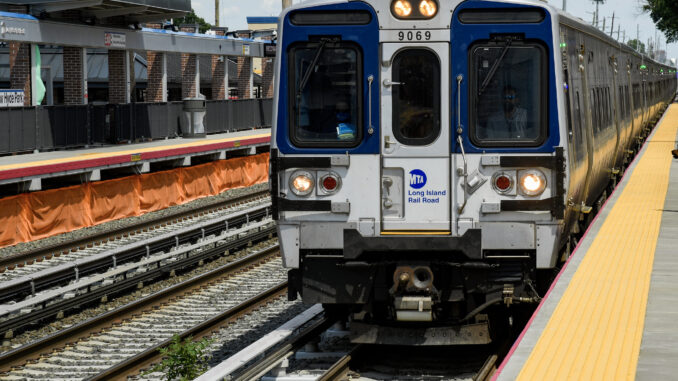
Additionally, the CBC called for conductor operating reform and modernizing fare validation on the Long Island Rail Road and Metro North Railroad, which would result in $618 million in savings. This is done by expanding the use of one-person train operation (OPTP) and reducing the need to collect fares onboard. This would allow the LIRR to have 663 fewer conductors on staff and 563 on staff for Metro-North.
“Attrition could help streamline these jobs as the system is phased in; other affected employees could be retrained and transferred to other roles in their railroads and given priority consideration for roles at other MTA agencies,” the CBC said in its report.
Installing these faregates in New York City, the CBC said, would have high upfront costs,but those costs “could be offset by recurring labor savings or innovative fare validation technologies that require less infrastructure than traditional faregates.”
Another cost-saving measure the CBC offered was to have MTA retirees and unionized employees to contribute more to their health insurance premiums. Currently, MTA retirees — unlike New York State retirees — do not pay towards their healthcare premiums, while those who currently work and belong to a union contribute only 2%. State retirees, meanwhile, pay 18% of the cost for healthcare (31% for family plans) and state employees at or above a grade 10 salary pay 26% towards their plans. MTA workers who are nonunion pay 18%. The CBC recommended in its report that MTA retirees paying the same amount as state retirees would save the MTA $318 million a year by 2029, while union employees who contributed the same amount as nonrepresented employees would mean $207 million in savings within the next three years.
The organization also said the MTA could the city, state and labor unions that represent its employees to redesign a value-base plan like what the NYC Municipal Labor Committee did. “NYC’s previous plan redesign reduced the plan’s costs by 12 percent compared to projections in 2018,” the report stated. “A similar achievement would save the MTA $361 million by 2029. Future plan redesigns could offer additional enrollment tiers that differentiate costs based on the enrollment of family composition or focus on prescription drug and plan utilization reforms that would reduce MTA costs while preserving plan quality.”
The CBC concluded, “The MTA’s services are critical to the region’s economy and quality of life. While implementing these recommended changes will be challenging and take time, they help ensure the MTA’s long-term fiscal stability so that it can continue to provide services that support the region.”
Long Island Life & Politics reached out to the MTA for comment. “The CBC is right to note that we’ve made extraordinary progress in securing hundreds of millions of dollars in new recurring operational efficiencies,” said Mitch Schwartz, MTA’s senior advisor for policy and external relations. “And we welcome their endorsement of the cost saving and productivity initiatives that are central to Next Stop: Faster Buses, Better Service, the report we co-authored earlier this year.”